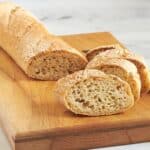
Gluten-Free French Baguette
This gluten-free baguette recipe yields two French-style loaves with a soft, airy crumb, a tender, slightly squishy interior, and a thin, crisp crust.
Servings 28 slices
Calories 72kcal
Equipment
- 1 Stand Mixer optional but very helpful
- 1 French bread pan optional but nice
Ingredients
- 3⅞ cups Cathy's Gluten-Free Bread Flour Blend
- 2 tablespoons raw sugar
- 2 teaspoons fine sea salt
- 2 teaspoons instant yeast
- 2 cups warm water 110℉-115℉ (43℃-46℃)
- 1½ tablespoons olive oil
- 2 teaspoons apple cider vinegar
Instructions
- Whisk the dry ingredients together in the bowl of your stand mixer or a large mixing bowl.3⅞ cups Cathy's Gluten-Free Bread Flour Blend, 2 tablespoons raw sugar, 2 teaspoons fine sea salt, 2 teaspoons instant yeast
- Add the wet ingredients.2 cups warm water, 1½ tablespoons olive oil, 2 teaspoons apple cider vinegar
- Run the mixer with a dough hook on low speed until everything is combined. Then, run it on low-medium speed for about 6 minutes. Alternatively, work the dough by hand vigorously until it is smooth but sticky.
- Meanwhile, oil your pans.
- On a lightly floured surface (Any gluten-free flour will do.), divide the dough into two even parts. Roughly pat each into a rectangular shape. Starting with a long side, press and roll it into a log shape almost as long as your pan.
- Carefully place each loaf onto your prepared pan. Cover loosely with oiled plastic wrap and let them sit in a warm room for an hour to an hour and a half, until increased by about 50% in size.
- Meanwhile, position a rack in the center of your oven where your loaves will bake. If your oven has a steam bake setting, add water to it before preheating. Otherwise, set a metal pan on a lower rack in the oven. Preheat the oven to 480℉ (250℃).
- If you placed a metal pan in the bottom of your oven while it was preheating, toss a handful of ice cubes into it now. Being careful of the steam, place your loaves onto the middle rack and bake for 10 minutes.
- Turn the heat down to 425℉ (220℃). Remove the ice cube pan. (The water in a steam oven will have all evaporated by now.) Continue to bake the bread for 20 minutes more without steam.
- Remove the browned loaves and set them on a wire rack to cool. Gluten-free bread should be cooled completely before slicing, or it will be gummy.
Video
Notes
This gluten-free bread is simple to make and easy if you have a stand mixer. Just be mindful of a few tips when you're baking with yeast:
- Use fresh yeast. It will keep in the freezer if you don't use it often.
- The warm water should not exceed 115°F (46°C) when it comes into contact with the yeast.
- An ideal environment for proofing (rising) bread dough is a humid 80°F (27°C). Warmer than that is great for it; in a cooler room, it will simply take longer.
Nutrition
Serving: 1slice | Calories: 72kcal | Carbohydrates: 15g | Protein: 1g | Fat: 1g | Saturated Fat: 0.1g | Polyunsaturated Fat: 0.2g | Monounsaturated Fat: 1g | Sodium: 168mg | Potassium: 31mg | Fiber: 2g | Sugar: 1g | Vitamin C: 0.003mg | Calcium: 2mg | Iron: 0.5mg
